An ordinary life in an extraordinary world © Christine Rivers
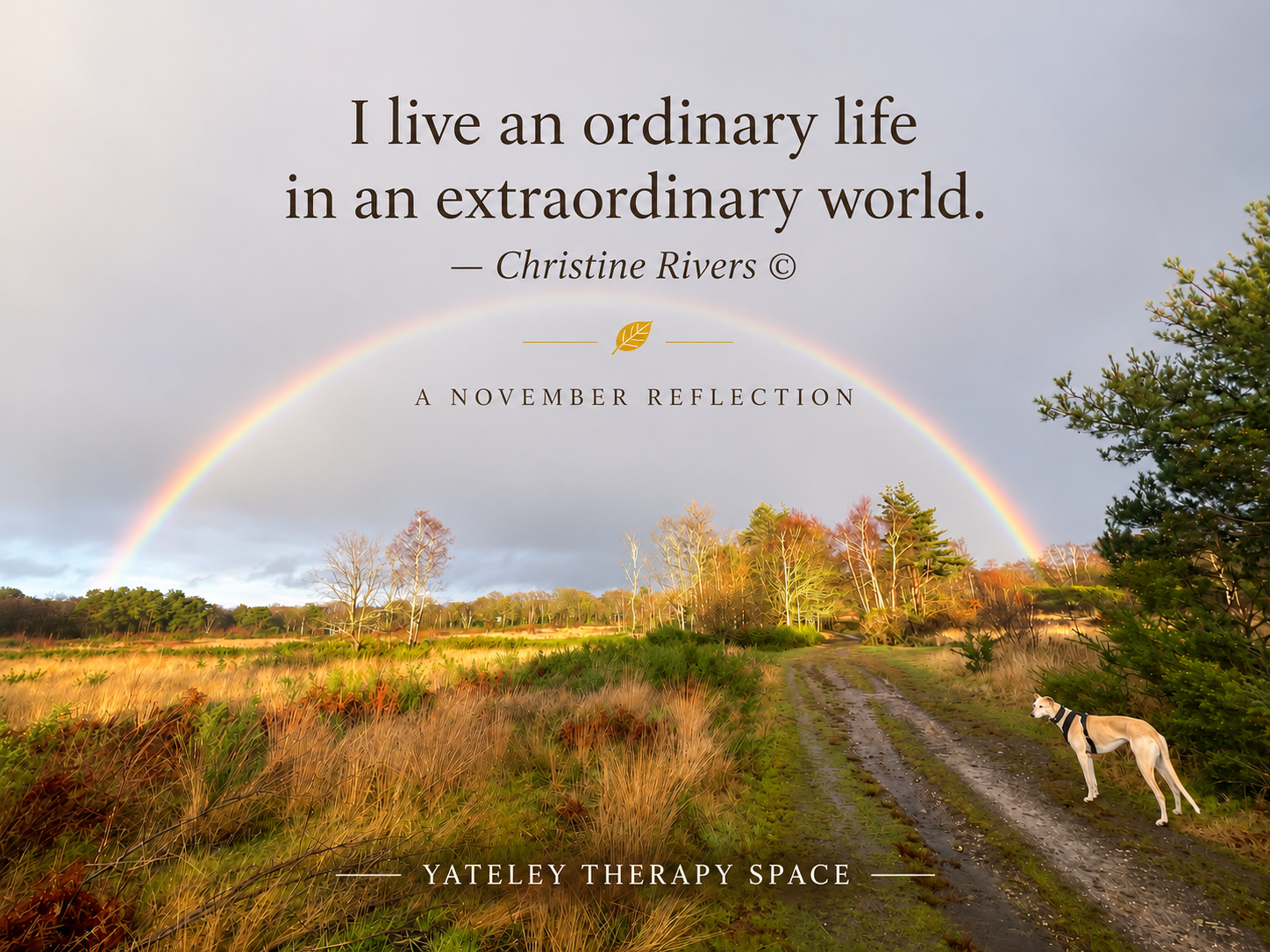
“I live an ordinary life in an extraordinary world.”
These words came to me recently while out walking with my dog. It was an ordinary autumn morning, and a rainbow appeared across the sky. Nothing particularly remarkable was happening, and yet something about that moment stayed with me.
I have been reflecting quite a lot lately on identity, on who we are, who we think we ought to be, and how much of ourselves becomes shaped by the expectations we carry. Some of these reflections have emerged through my ongoing development as a psychotherapist, where questions of identity, power, authority and our relationship with ourselves and others are never far away.
And then, quite unexpectedly, came this thought: I live an ordinary life in an extraordinary world.
What does it mean to be ordinary?
I found something rather freeing about it yet we don't often aspire to be ordinary. My curiosity led me to explore the word ordinary and its meaning. Ordinary comes from the Latin ordinarius, meaning regular, customary or belonging to the usual order of things. Over time, however, ordinary has also come to suggest something unremarkable, perhaps even mediocre.
In fact, we celebrate extraordinary achievements, extraordinary people, extraordinary experiences. Social media offers us endless opportunities to observe lives that appear more successful, more adventurous, more beautiful or more meaningful than our own. Even our personal development can become another project of becoming extraordinary. We should be more resilient, more mindful, more productive, more fulfilled. But I wonder what happens when being extraordinary becomes an expectation rather than a possibility and who decides what extraordinary actually means?
What is considered successful, desirable or remarkable is not universal. These ideas are shaped by our culture, our relationships, our histories and the societies in which we live. Perhaps we spend much of our lives measuring ourselves against standards that we have never consciously chosen. The extraordinary is not always wonderful or at least in my experience because there is another side to this reflection.
The other side extraordinary
We tend to associate extraordinary with something positive. Yet extraordinary simply means beyond what is usual or expected, not that it is positive per se. An unexpected achievement might be extraordinary. So might falling in love, witnessing something beautiful or experiencing an extraordinary opportunity. However, illness, grief, anxiety, trauma and profound uncertainty can also be extraordinary experiences sometimes resulting in a lot of suffering or someone finding new meaning in life. Sometimes life becomes extraordinary in ways we would never have chosen. And perhaps this is where the ordinary lens becomes particularly interesting.
The ordinary lens
What happens when we experience something extraordinary, whether welcome or unwelcome, without feeling that we ourselves must become extraordinary in response? When life is difficult, we might believe that we should cope exceptionally well, recover quickly or demonstrate remarkable resilience. When life is going well, we might feel pressure to sustain our achievements, maintain our success or continue becoming more. Both can create expectations that subtly change our relationship with ourselves. I wonder whether allowing ourselves to be ordinary might remove some of that pressure, pressure of expectation to act “normal”. Not because we are worth less, or because we should abandon ambition, but because our worth need not depend on the experiences we have or the identities we construct around them.
Being rather than becoming
Alongside my own discovery with the “ordinary lens” I was reading To Have or To Be? by the philosopher and psychoanalyst Erich Fromm, who explored the distinction between having and being. In his book To Have or To Be?, he questioned how easily our sense of self becomes organised around possession, achievement and status rather than the experience of living.
I find myself wondering whether the ordinary lens offers another way of exploring this distinction. I can be an ordinary professor, an ordinary psychotherapist, an ordinary mother, an ordinary person. These roles remain meaningful. My work still matters. My relationships still matter. I can continue to learn, develop, contribute and pursue things that interest me. But I know and you know too that I don't need these roles to establish that I am somebody and there is something quite liberating in that thought. I can experience extraordinary things without needing to become extraordinary myself. And equally, I can experience difficult, painful or disappointing things without allowing them to define who I am.
Perhaps ordinariness is not the opposite of significance after all. Perhaps it is freedom from the constant need to establish significance.
The ordinary lens is beyond reframing
I wondered whether changing the lens is just another way of reframing, because in psychotherapy, we often talk about reframing an experience. But I have been thinking about the metaphor of reframing quite literally. Imagine an unpleasant picture. We might place it in a different frame, perhaps a more attractive one. The picture itself has not changed. It might still be ugly, painful or difficult to look at. Does the new frame necessarily make it easier to see? I'm not sure. A lens, however, offers something different. Looking through a different lens might allow us to notice details, depth, relationships and perspectives that were previously unavailable to us and sometimes the lens itself needs cleaning. Our perception can become clouded by expectations, comparisons, fears, assumptions and judgements. These may narrow what we notice and how we understand our experiences. Cleaning the lens does not make an unpleasant picture beautiful. It doesn't remove suffering, deny reality or require us to find something positive in every difficult experience but perhaps it allows us to see more clearly and that’s exactly what my clients often refer to. They don’t say I see reframed now, no they say, I can see clearly now.
The ordinary lens and mindfulness
To notice that an experience is painful without concluding that we are failing. To recognise an achievement without needing to construct an identity around it. To experience uncertainty without immediately demanding certainty. This is where I see a connection with mindfulness. Mindfulness invites us to become aware of our experience without immediately judging, resisting or trying to change it. And perhaps the ordinary lens offers a similar invitation. Not to make our lives extraordinary, but to become more available to the lives we are already living.
The ordinary lens in everyday life?
You might wonder but how does that help me day to day? If I share a short example it might be hepful: Consider someone experiencing anxiety. The anxiety itself may be difficult enough. But often there is another layer: Why am I like this? Why can't I cope? I should be stronger. I should be better by now. The person is no longer simply experiencing anxiety. They are also evaluating themselves through it. What might happen if they could recognise themselves as an ordinary human being having a difficult human experience? The anxiety may not disappear. Their circumstances may remain unchanged but perhaps the additional burden of expectation might soften.
Or consider someone who has achieved considerable professional success.What happens when success becomes part of their identity, something that must continually be protected, demonstrated or surpassed? Perhaps the ordinary lens allows achievement to remain an experience rather than becoming a measure of personal worth.
I wonder whether this might also apply to parenting, relationships, ageing, grief and the countless ordinary challenges of being human. We don't always have to be exceptional in how we navigate them. Sometimes being human is enough. Freedom in the ordinary but what interests me most is the possibility of freedom not necessarily freedom from life's circumstances, but freedom within them. I can live an ordinary life without needing it to become something different before I allow myself to experience it fully. This doesn't mean becoming passive, giving up aspirations or accepting circumstances that need changing. It means perhaps loosening the relationship between who I am and what happens to me. I can still strive, achieve, struggle, fail, learn, love and grow. But I don't have to turn every experience into a judgement about myself. And perhaps there is something quietly radical about that in a world that constantly encourages us to become more.
The rainbow eventually disappeared that morning, as rainbows do. I continued walking with my dog. Nothing in my life had changed. I still had the same responsibilities, commitments, aspirations and uncertainties. Yet something about how I was relating to them felt different. I was simply an ordinary person, walking through an extraordinary world. And for that moment, there was nothing more I needed to be.
An invitation to reflect
Where in your own life do you feel the expectation to be extraordinary? Perhaps in your work, your relationships, your achievements, or even in how you believe you should cope with difficulties. What might you notice if you looked at that part of your life through an ordinary lens? Not to change the picture, or make it more beautiful than it is, but simply to see what else might be there.