Why searching your symptoms online can make anxiety worse
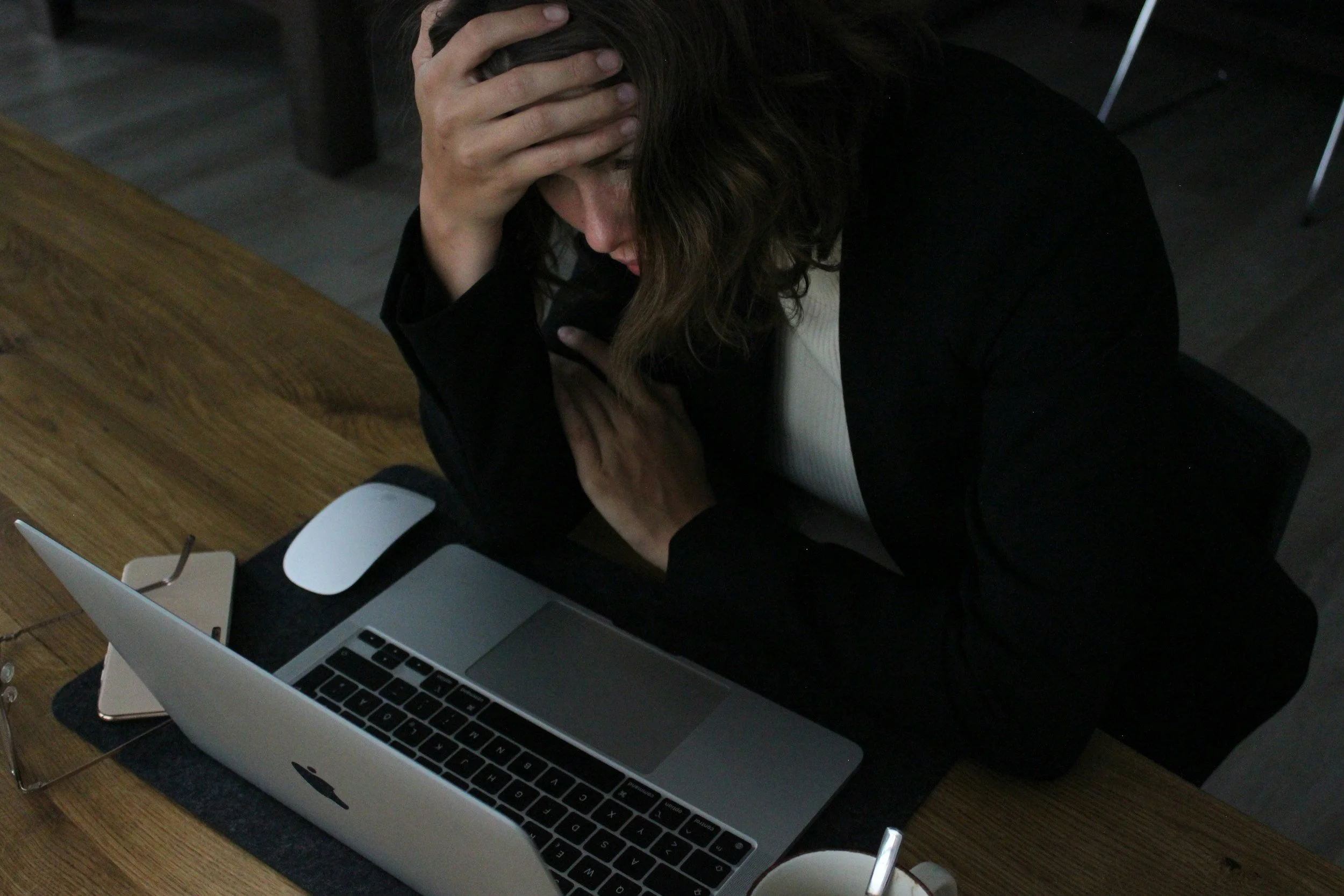
Women searches for symptoms online and feels anxious
You might notice a sensation in your body and feel a strong urge to look it up. It could be something small such as a headache, a tight chest or a feeling of dizziness. Within moments, you may find yourself searching online, trying to understand what it means.
At first, this can feel helpful. You are trying to make sense of what is happening and reassure yourself. But often, this process does not bring lasting relief. Instead, it can leave you feeling more uncertain, more alert and more anxious.
If this sounds familiar, you are not alone.
What is happening when you search symptoms
When you experience a sensation in your body, your brain naturally tries to understand whether it is safe or dangerous. This is part of your nervous system working to protect you. Research shows that anxiety involves brain systems linked to threat detection and survival. These systems can become more active over time, especially when the brain learns to scan for possible danger.
https://www.sciencedirect.com/science/article/pii/S0140673621003597 When you search your symptoms, you are trying to reduce uncertainty. However, the information you find is often general, worst case focused or not specific to you. This can increase your sense of threat rather than reduce it.
The cycle of reassurance and anxiety
Many people find themselves caught in a repeating pattern. A sensation appears in the body. This creates concern. You search online or check your body. For a moment, you may feel reassured, or sometimes more alarmed depending on what you read. Soon after, the doubt returns. This pattern is sometimes described as a reassurance cycle or cyberchondria, where repeated online searching increases anxiety rather than resolving it. Over time, the urge to check becomes stronger, even though it does not bring lasting relief.
Why reassurance does not last
It might seem like the problem is not having enough information, but often the opposite is true. The more you search, the more your brain learns that something might be wrong. This keeps the nervous system in a state of alert. Research suggests that reassurance seeking can temporarily reduce anxiety, but it often reinforces the underlying worry, making it more likely to return. This is why you might feel stuck in a loop where you keep checking, even though it does not help in the long term.
This is not something you are doing wrong
It is important to understand that this pattern is not a personal failure. It is how the brain tries to protect you. Your system is responding to uncertainty by trying to find answers. The difficulty is that this strategy becomes unhelpful over time. Health anxiety often develops gradually and can feel very real, especially when physical sensations are involved.
https://www.nhs.uk/mental-health/conditions/health-anxiety/
What can help
Rather than trying to stop the anxiety completely, it can be helpful to understand how the cycle works for you. This includes noticing:
what triggers the urge to search
how your body responds
what happens after you check
From there, it becomes possible to gently interrupt the cycle and respond in a different way. Therapy can support this process by helping you understand the connection between thoughts, body sensations and behaviour, and by supporting your nervous system to settle over time.
A focused step if this feels familiar
If you recognise yourself in this, you do not have to keep managing it alone. I offer a focused session for health anxiety. This is a single session where we take time to understand what is happening for you, explore the cycle of worry and checking, and begin to find a different way forward. This is not a medical consultation, but a space to work with the anxiety around symptoms and how it is affecting you. You are welcome to get in touch to arrange a session or an initial conversation to see if this feels right for you.
References & Useful Links
Health anxiety overview (UK NHS)
https://www.nhs.uk/mental-health/conditions/health-anxiety/
NICE guidelines for anxiety disorders (UK standard)
https://www.nice.org.uk/guidance/cg113
British Psychological Society overview of anxiety
https://www.bps.org.uk/public/understanding-psychological-problems/anxiety
Academic paper on cyberchondria
https://www.ncbi.nlm.nih.gov/pmc/articles/PMC2924964/
Review paper on anxiety disorders (The Lancet)
https://www.sciencedirect.com/science/article/pii/S0140673621003597